
Tools and providers
Part of Choosing tools and suppliers for a gaming channel by drawing the workflow first
Choosing gaming channel software by testing real workloads and planning the exit
Select software for an England gaming channel by testing real workloads, checking platform fit, controlling data access and planning a workable exit.
Software selection should begin with one production job, not a catalogue of features. For an England-based gaming creator, the useful question is whether a candidate can complete the intended capture, edit, publication or community task on the available equipment, with acceptable recovery and data controls.
This is a desk-research method, not a product comparison, checked on 5 September 2026. The categories in scope include capture software, video editors and cloud studio tools. Product availability is generally global, while the security and data-protection references are UK-wide. It does not declare a universal winner or report hands-on testing.
What to take away
- Start software selection with one real production job rather than a catalogue of features.
- Test the demanding workload, not an empty project, because minimum specifications do not prove usable performance.
- Check the destination's current instructions instead of trusting a supplier's compatibility badge.
- Map accounts, permissions and data handling before committing to any tool.
- Keep the old workflow until the new one has completed a normal production cycle.
Define the job and the failure limit
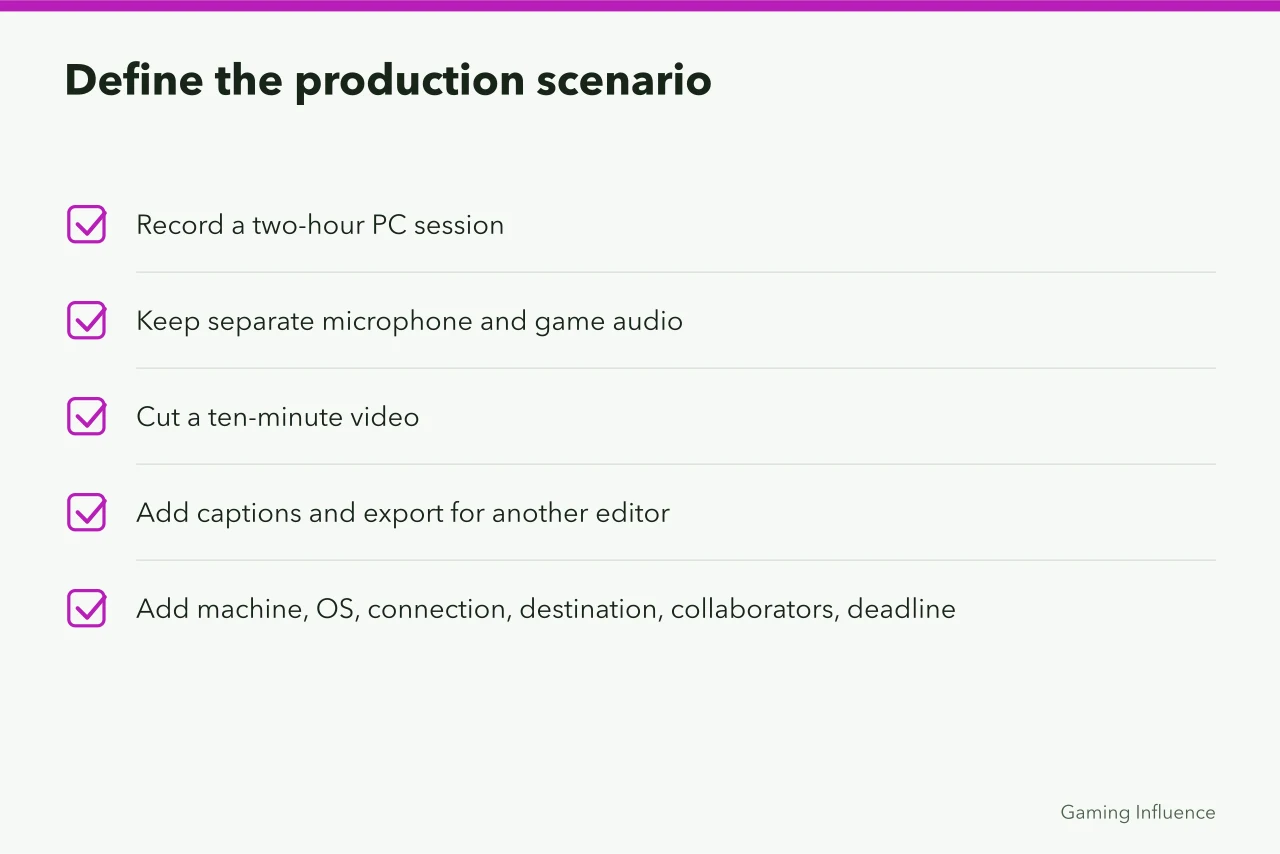
Write a short scenario such as: record a two-hour PC session, keep separate microphone and game audio, cut a ten-minute video, add captions and export the project for another editor. Add the machine, operating system, connection, channel destination, collaborators and deadline.
Disqualifying failures
Does the product support your hardware?
continue testing
disqualify the product
Then name failures that disqualify a product. Examples include unsupported hardware, no acceptable project export, a single shared administrator login, unclear handling of private moderation material, or an output that the destination rejects. Keep desirable extras separate from these gates.
Minimum specifications alone are not proof of usable performance. The OBS Studio requirements page says capacity varies with encoder, resolution, frame rate and scene complexity, even when the basic requirements are met. Use the same principle for any editor or cloud studio: test the demanding workload, not an empty project.
Check the whole route
List the required inputs and outputs. For capture software that could mean a game source, camera, capture card, two audio tracks, local recording and a live destination. For editing, specify the captured codec, caption format, thumbnail dimensions and archive package. For community work, document permissions, alerts, evidence retention and handover between moderators.
Open the destination's current instructions instead of trusting a supplier's compatibility badge. YouTube's live encoder guidance sets out supported protocols and settings, recommends choosing quality around the actual upload connection, and tells creators to test realistic sound and movement before an event. A candidate passes only when the destination accepts the test output and the local recording remains usable.
Examine accounts, information and support
Map every sign-in and integration. Record who owns the main account, which permissions a freelancer needs, how access is revoked and whether multi-factor authentication is available. Identify any audience handles, email addresses, sponsor files or private reports sent to the service.
For a low-sensitivity cloud tool, the NCSC's lightweight cloud assessment asks about encryption, access control, logging, incidents and governance. It recommends the fuller cloud principles for sensitive workloads. A marketing security page is evidence from the supplier, not independent assurance.
Where the service processes personal information for the creator, establish the roles and contract requirements. The ICO's controller and processor guidance addresses security, subprocessors, assistance, audit and end-of-contract provisions. Obtain qualified advice for the actual arrangement.
Run a scored trial
Use a copy of representative material and a non-public destination. Time setup and the routine task, note errors, inspect the output, and ask a second user to follow the handover notes. Test account recovery, removal of a collaborator and export of settings or projects.
Do not expose a real stream key or viewer record merely to make the pilot realistic.
Score only the stated needs. A simple pass, partial, fail scale is often clearer than invented precision. Record the page and access date supporting each claimed feature, then distinguish it from behaviour observed during the trial.
Worked example: the two-hour recording runs to time, the ten-minute cut exports in 12 minutes (illustrative) and the captions import cleanly, so capture, edit and export pass. The handover fails because the second editor cannot open the project without the owner's login. That is a partial result, not a pass.
Make the decision reversible
The final note should identify the selected edition, account owner, approved integrations, renewal route, training task, backup location and rollback date. Preserve the old workflow until the new one has completed a normal production cycle. If the supplier cannot explain export, deletion or incident handling, keep that uncertainty visible rather than turning it into a favourable score.
Before you act
- Write a short production scenario with machine, deadline and collaborators.
- Name the failures that rule a product out before comparing extras.
- List the inputs and outputs along the full chain.
- Test realistic output against the destination's current instructions.
- Map sign-ins, permissions, revocation and multi-factor authentication.
- Trial a copy of representative material and score each stated need.
Common questions
Why are minimum specifications not enough to judge performance?
Performance depends on the workload, not the minimums. Test the demanding task rather than an empty project.
What should be checked about accounts and integrations?
Map every sign-in and integration. Record who owns the main account, which permissions a freelancer needs, how access is revoked and whether multi-factor authentication is available. Also identify audience handles, email addresses, sponsor files or private reports sent to the service.
How should a trial be run without exposing real data?
Use a copy of representative material and a non-public destination. Time setup and the routine task, note errors, inspect the output, and ask a second user to follow the handover notes. Do not expose a real stream key or viewer record merely to make the pilot realistic.