

Audience research
Part of Researching a gaming audience that starts with a decision, not a demographic
Auditing rival gaming channels for audience task, discovery and commercial evidence
Audit gaming content competitors in England with a dated checklist for audience task, format, discovery, engagement and commercial evidence.
Compare channels that solve the same audience problem, not simply the largest creators covering the same game. A walkthrough, an esports analysis stream, a comedy clip and an official publisher update may mention one title while competing for different attention.
Use this checklist for a dated public audit. It can reveal content gaps and test a positioning choice. It cannot disclose another creator's private income, audience residence or conversion rate.
What to take away
- Compare channels that solve the same audience problem, not simply the largest creators covering the same game.
- Public platform measures show discovery and engagement signals.
- Judge production polish only after defining the viewer outcome the content is meant to deliver.
- Visible advertising, affiliate material and public offers suggest business models rather than actual revenue.
- Finish with a single change tested across a small run of content, then repeat the observation later.
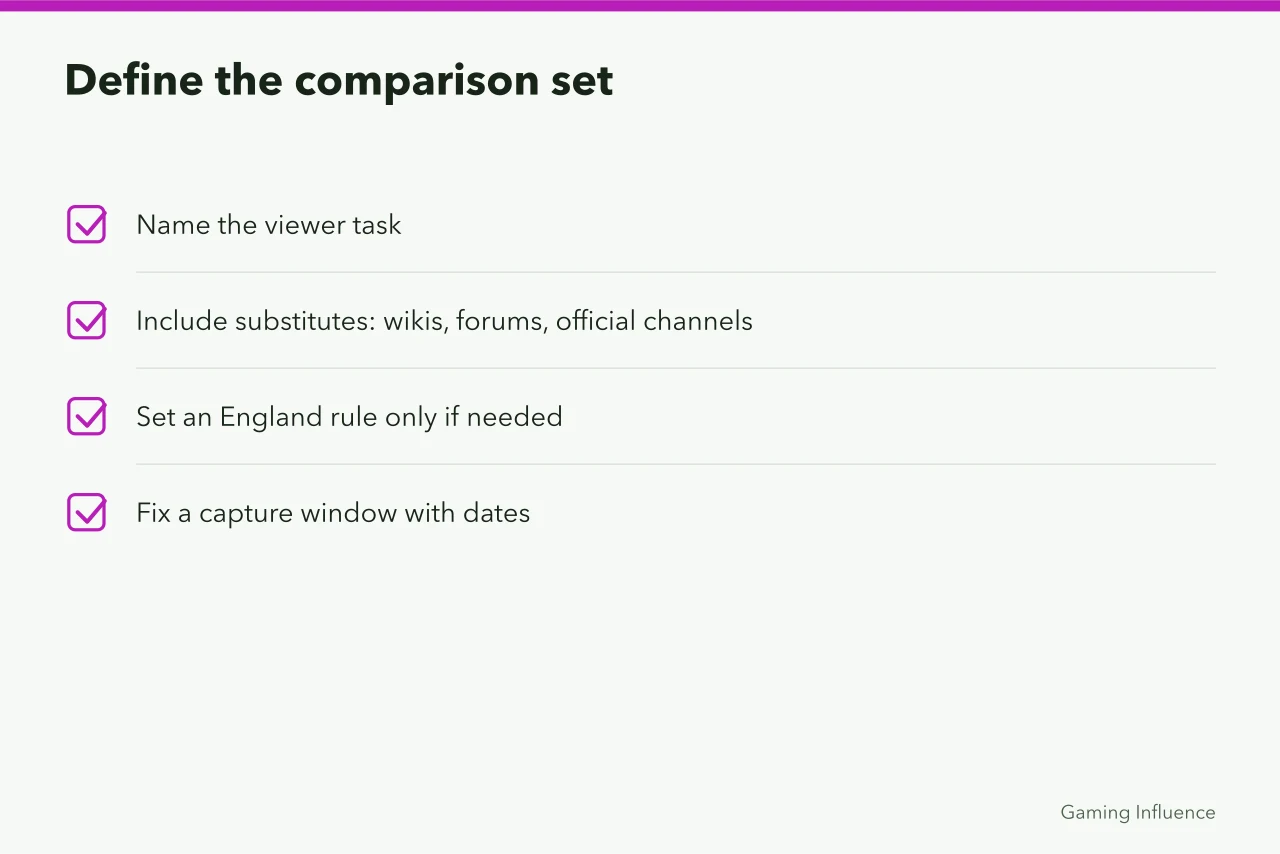
Define the comparison set
- Name the viewer task.State whether the audience wants to pass a level, follow a tournament, judge a purchase or spend time with a live community.
- Include substitutes.Search official game channels, wikis, forums, in-game help and specialist publishers as well as individual creators.
- Verify an England or UK proposition.Check Companies House for a company number, the channel's privacy policy or terms for a UK postal address, and the ASA resources for a UK disclosure. Treat an England claim as unverified without one of those records.
- Fix a capture window.Note the date and the period observed so a release week is not compared casually with an ordinary month.
YouTube's Audience report documentation says a creator may see channels, content and formats watched by their own audience. These views cover specified recent periods and some audience data can be limited. Use them to find candidates, then check whether each candidate addresses the same task.
Beyond that report, build candidates from public lists. Use game publishers' creator programmes, tournament and convention participant lists, platform category pages, forum sidebars and England-specific properties such as the ePremier League. Record the source and date for each name so the comparison set is reproducible.
Illustrative audit row (replace with your own captures):
| Task | Channel | Measure | Date |
|---|---|---|---|
| Pass a level | Rival A | Public views in first 7 days | 12 March 2025 |
This row is a template, not a real channel record.
Record the audience promise
- Copy the stated proposition in your own notes.Identify what the title, description and opening tell a new viewer they will receive.
- Log game and experience level.A guide for a first-time player is not interchangeable with advanced build analysis.
- Identify the format.Record livestream, edited video, Short, clip, article or community resource.
- Check accessibility signals.Note captions, readable on-screen detail, spoken explanation and any published schedule.
Do not score production polish without defining the viewer outcome. A lightly edited answer may solve a search task better than a long broadcast; a live programme may succeed through participation rather than replay completion.
Record the audience promise
- Copy the stated proposition into notes
- Log game and experience level
- Identify the formatstream, video, Short, clip
- Check accessibility signals and schedule
Capture discovery and engagement carefully
Capture discovery and engagement
- Save the public title, thumbnail claim and publication time.Note later changes where the platform exposes them.
- Record comparable public measures.Use the same age window and format. Views, followers, concurrent viewers and comments have different meanings.
- Read questions, not just totals.Repeated public questions may reveal a missing explanation, but remove usernames from the research notes unless identity is necessary.
- Check your own referral data.A competitor may appear important in search while contributing little overlap with the existing community.
Twitch's Analytics overview separates overall, discovery, engagement and research information. It also describes category-level signals for planning streams.
Two windows are enough for most audits: 7 days for a release week and 28 days for an ordinary month. Apply the same window and format to every channel in the set.
Capture discovery and engagement
- Save title, thumbnail claim and publication time
- Record comparable public measures, same age window
- Read repeated questions, remove usernames
- Check your own referral data for overlap
Examine the commercial presentation
- Mark visible advertising and affiliate material.Record what is promoted and where the disclosure appears.
- Note public offers.Memberships, events, merchandise or services show possible business models, not revenue.
- Check brand fit against evidence.A creator's follower total alone does not reveal audience suitability or campaign results.
The ASA's influencer marketing resources collect current UK guidance for creators, agencies and brands on identifying advertising. Use that record to review your own commercial process. Do not allege that a competitor breached a rule from an ambiguous screenshot.
Finish with a specific test
Summarise one underserved task, one practice the audience already understands and one assumption that still needs evidence. Then change a single element, such as the promise, video length, captioning or schedule, across a small run of content.
Choose the measure before publishing and compare it with similar work on the same channel. Repeat the observation later because rankings, public counts and formats move. The value of the exercise is a better test, not a league table.
Before you act
- Name the viewer task before selecting channels
- Include substitutes such as wikis, forums and official channels
- Fix a capture window and record the dates
- Copy the stated proposition into your own notes
- Record comparable public measures using the same age window
- Remove usernames from research notes unless identity is necessary
Common questions
How should I choose which channels to compare?
Start with the viewer task, not the largest channel. Use YouTube's audience report and the source list above, then check each candidate against that task.
What can a public audit of rival channels actually show?
It can reveal content gaps and test a positioning choice. Treat the result as a hypothesis for your own next test, not as proof of another creator's performance.
How do I handle commercial evidence without making accusations?
Record the disclosure placement, not just the ad. Use the ASA resources to check your own process. Do not allege a breach from an ambiguous screenshot.